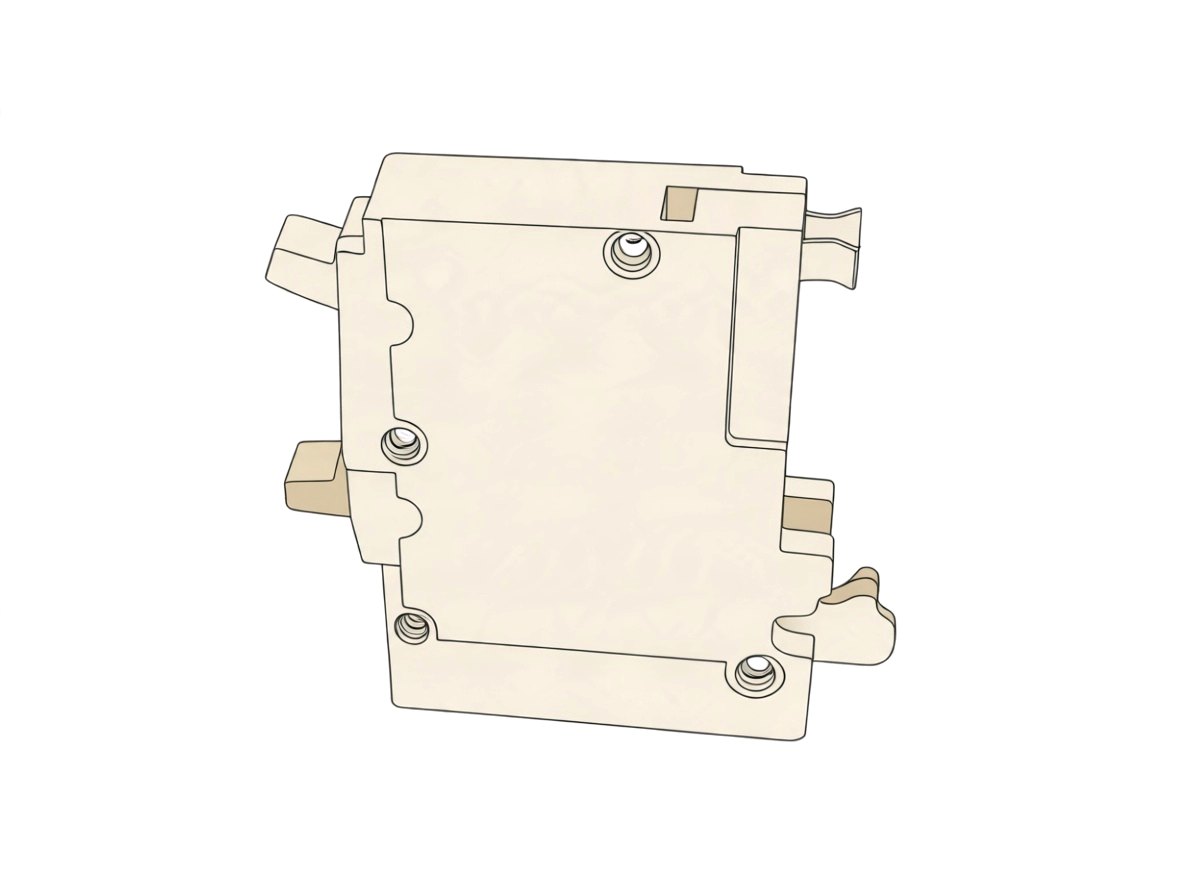
How it connects
Non-electrical mechanical latching where the hook/clip on the breaker case snaps over or hooks onto the metal mounting rail of the panel interior, providing physical retention and pivot alignment before the bus jaw engages.
Male and female halves
The circuit breaker body features the retaining hook/clip (often male/protruding or grasping clip) while the panel interior mounting pan features the complementary raised metal rail or locating seat (female/slotted receiver).
Usually connects to
- Square D QO panelboard mounting rail
- load center interior breaker mounting pan tab
Common sizes
- Designed for standard Square D QO 3/4-inch pole widths (1-pole, 2-pole, 3-pole miniature circuit breakers).
Where it is used
residential electrical panelscommercial electrical panelboardsload centers
Variations
- Spring-steel / metal mounting rail clip
- Molded plastic retaining hook / tab
- QOT tandem mounting hook with rejection feature
How to recognise it
Recognized as a metal clip or molded hook tab located on the base opposite the bus stabs/terminal lug of a miniature circuit breaker, designed to latch over a sheet-metal ridge or rail in the panel chassis.
Often confused with
| Confused with | How to tell them apart |
|---|---|
| Square D Homeline mounting hook | Square D Homeline uses 1-inch pole spacing and a different clip geometry compared to the 3/4-inch QO mounting rail footprint. |
| Circuit breaker bus bar stab jaw | The bus bar stab jaw is the conductive electrical terminal that slides onto the hot/neutral panel bus stabs, whereas the retaining hook is strictly a mechanical mounting feature on the opposite edge of the breaker. |
Also called
QO mounting rail clipcircuit breaker mounting footload center breaker retention hookpanelboard mounting rail clip
Good to know
In Square D QO breakers, the mounting clip hooks onto the interior panel rail to anchor the breaker mechanically. The complementary panel side features a stamped steel rail or tab along the outer edge of the chassis.
Design with real parts
Crafti checks which parts connect, right in your browser.