How it connects
Gravity/load engagement: the mating link is pushed through the throat, deflecting the spring latch inward; the latch snaps closed behind it to prevent accidental disengagement when slack. Load bears on the bowl saddle; no seal.
Male and female halves
The hook bowl/throat is the receiving (female) side; the inserted link, eye or shackle bow is the male side. This is the hook's working end; the hook's other end is usually an eye, clevis or swivel for attachment to the hoist.
Usually connects to
- sling eyes and wire rope thimbles
- master links and oblong links; chain links
- shackle bows
- lifting eyes / eye bolts / padeyes; eye bolts and pad eyes
- rope or webbing loops
- collar/harness rings; O-rings, D-rings and eyes
Common sizes
- Small snap hooks commonly 2-1/2–5 in overall, with 1/4–3/4 in gate openings; a 3-1/2 in example fits 3/4 in rope, and another names 1/4 in rope. Rope size is not a universal hook diameter.
- Hoist hooks have manufacturer-specific dimensions, throats around 20–100+ mm and working-load ratings roughly 0.25–30+ t.
- End styles include fixed/swivel round, oval or strap eyes, and double-ended hooks; check gate and captured-object clearance.
Where it is used
overhead cranes and hoistschain and wire rope slingsmaterial handlinglivestock and equestrian tackmarine and flagpole rigging; flagpole halyards; marine and boatingrope and strap hardwaregates and chainspet leashes and tack
Variations
- eye hoist hook; clevis hoist hook
- swivel hook; shank hook
- sling/slip hook
- self-locking hook (positive lock, no separate latch)
- fixed round eye; swivel round eye
- swivel strap/square eye for webbing
- double-ended bolt snap
- stainless, zinc, brass, malleable iron
How to recognise it
Forged C/J-shaped hook with a wide rounded bowl, an attachment eye/clevis/swivel at the top, and a stamped-steel spring latch pinned near the shank bridging to the hook tip. Often marked with WLL and maker name.
Often confused with
| Confused with | How to tell them apart |
|---|---|
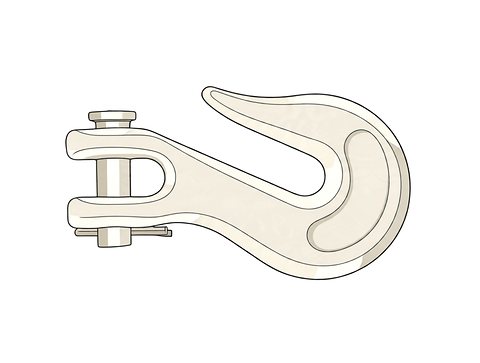
| Grab hook | Grab hooks have a narrow, straight-sided slot sized to one chain link thickness for shortening chain; hoist hooks have a wide rounded bowl and usually a latch. |
| Self-locking hook | Self-locking hooks have a pivoting body/trigger that locks closed under load rather than a thin spring latch flap. |
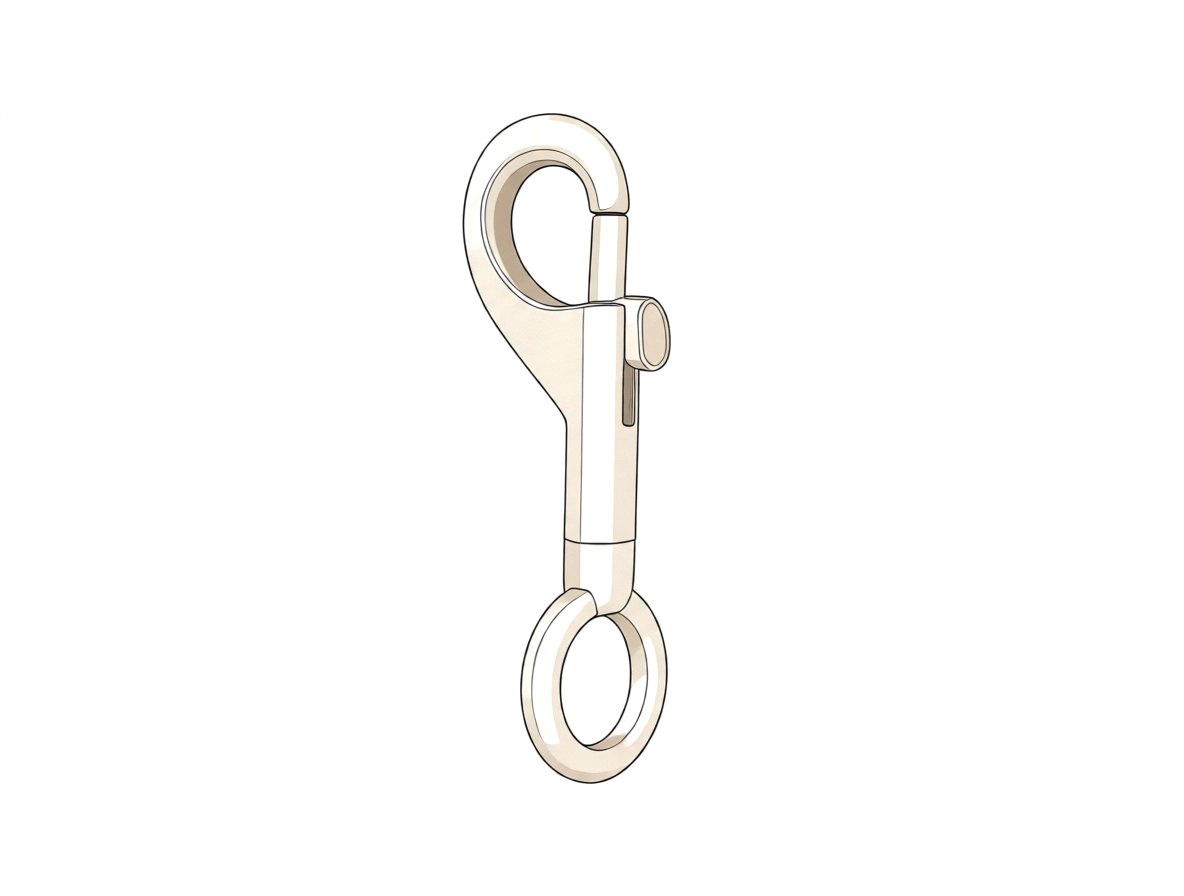
| Spring gate snap hook / carabiner | Snap hooks have a gate spanning a fully closed loop and are not rated crane hardware; hoist hooks are open forgings with a bolted-on latch at the tip. Those have a hinged gate that swings inward; a bolt snap's gate is a straight plunger sliding along the shank with a thumb tab. |
| Trigger snap | A trigger snap uses a pivoting lever gate pressed by the thumb, not a sliding bolt. |
| Quick link / shackle | Those close with a threaded sleeve or pin, not a spring. |
Also called
hoist hook with latch; slip hook with latcheye hoist hook bowlcrane hook saddlelatched hook throatslide bolt snap; swivel bolt snaptrigger snap (loosely); trigger-less bolt snapsliding bolt snap hook; double ended bolt snapspring snap; lead snap
Good to know
The load-bearing hook bowl has manufacturer-specific dimensions. Select by working-load limit and throat opening rather than appearance alone.
Related connections
Design with real parts
Crafti checks which parts connect, right in your browser.