How it connects
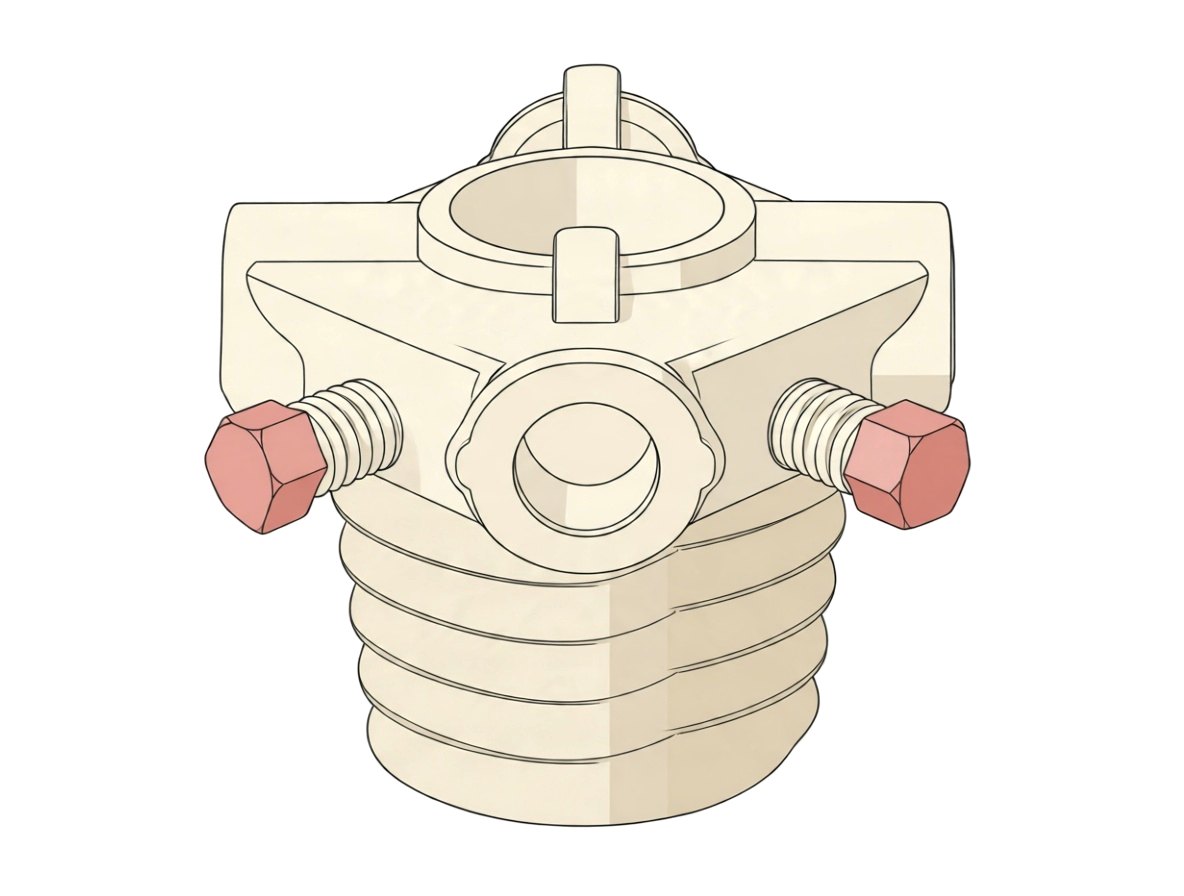
The cylindrical bore slides over the torsion shaft and is locked into place against rotational and axial movement by tightening two square-head steel set screws against the shaft.
Male and female halves
Female cylindrical bore mating over a male cylindrical overhead torsion shaft.
Usually connects to
- Matching 1 or 1-1/4 in garage torsion shaft, solid/keyed bar or hollow tube, with keyed/unkeyed fit as specified
Common sizes
- Common shaft bores: 1 in (25.4 mm) residential/light commercial, sometimes listed as 1.00–1.06 in ID; 1-1/4 in (31.75 mm) for heavier commercial doors.
- Cone exteriors fit spring IDs such as 1-3/4, 2, 2-1/4, 2-5/8, 3-3/4 and 6 in; this is separate from shaft bore.
Where it is used
residential garage doorscommercial sectional overhead doorscounterbalance torsion spring systemsrolling steel doorsindustrial rolling doorsoverhead sectional garage door systemsjackshaft wall-mount garage door openerscommercial roll-up doors
Variations
- 1 in residential or 1-1/4 in commercial bore
- Smooth or keyed shaft bore
- Dual radial set screws or keyway/set-screw arrangement
- Winding-cone/drum bore with threaded bosses
How to recognise it
Recognised by a cast aluminum or ductile iron hub featuring a 1" or 1-1/4" central hole, 2 threaded set screw holes with square-head set screws, and 4 perpendicular radial sockets around the hub face for inserting winding bars.
Often confused with
| Confused with | How to tell them apart |
|---|---|
| Stationary cone bore | The stationary cone has a flange with bolt holes to anchor it to the center support bracket, whereas the winding cone has winding bar holes and set screws. |
| Cable drum bore | Cable drums mount at the ends of the shaft with grooved perimeters for lifting cables, whereas winding cones fit inside the ends of torsion springs. |
| Rigid shaft collar / clamp collar | Shaft collars are narrow rings designed solely to locate components laterally, lacking winding bar sockets and spring grooved plugs. |
| Kee Klamp slip-on structural pipe fitting socket | Kee Klamp fittings are structural pipe framing connectors using hex socket grub screws, not cast torsion spring winding fittings with cross-holes for winding bars. |
| Keyed shaft bore | Torsion shaft slip bores are unkeyed, round smooth bores secured by set screws rather than a keyway and drive key. |
Also called
garage door torsion cone shaft holewinding plug shaft boretorsion spring winding cone shaft borestationary cone borecable drum boregarage door shaft boretorsion tube bore
Good to know
The winding cone is threaded into one end of a helical torsion spring. Technicians turn the winding cone with winding rods to tension the spring, then torque the set screws to transfer spring torque directly into the torsion shaft.
Related connections
Design with real parts
Crafti checks which parts connect, right in your browser.