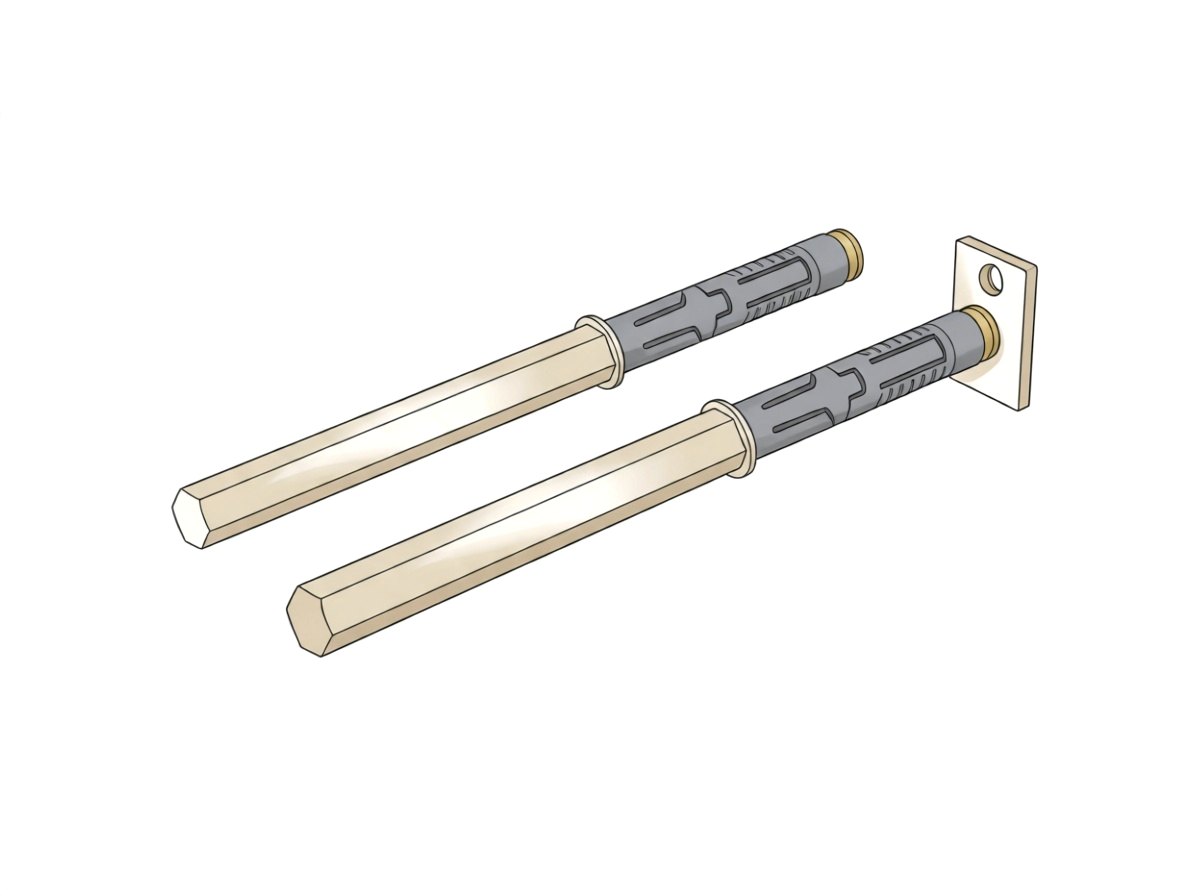
How it connects
The hexagonal rod inserts directly into a drilled cylindrical or routed hole inside the rear edge of the wooden shelf, holding it via close-tolerance friction fit and preventing rotation under load.
Male and female halves
Male projecting hexagonal rod that inserts into a female pre-drilled blind hole in the shelf body.
Usually connects to
- Matching blind cylindrical bore or routed channel in the floating shelf’s rear edge
- Matching concealed support sleeve/socket
Common sizes
- Support rods typically 10–20 mm (3/8–3/4 in), commonly 12 mm or 1/2 in (12.7 mm); some flat-sided descriptions use 10–14 mm AF.
- Projection spans roughly 75–300 mm (3–12 in), often 100–250 mm (4–10 in) or 4–8 in.
Where it is used
furniture hardwarecabinetryresidential shelvinginterior designfurniture makinginterior architectural woodworking; interior architectural millworkfloating shelf mounting; floating shelf installationfloating shelves
Variations
- Round solid-steel or hollow-tube support
- Hexagonal rod, including backplate-welded forms
- Eccentric/threaded height-adjustable support
- Integral expanding wall-plug/blind support
How to recognise it
A solid steel or zinc-plated bar with a hexagonal cross-section (usually 10-14 mm across flats) extending horizontally from a wall anchor, eccentric adjustment collar, or mounting backplate.
Often confused with
| Confused with | How to tell them apart |
|---|---|
| Round floating shelf rod | Round rods have a smooth circular profile, whereas hex rods feature six distinct flat sides allowing wrench tightening and preventing rotational play. |
| Cabinet shelf pin | Cabinet shelf pins are small pegs (typically 5 mm or 1/4 in) designed to support the underside of removable cabinet shelves, rather than embedding into a deep blind hole of a floating shelf. |
| cabinet shelf support peg / pin (5mm or 1/4 in) | Cabinet shelf pegs insert vertically into cabinet side panels to support exposed shelves, whereas floating shelf insertion rods extend horizontally 4-10 inches deep inside the shelf core. Cabinet shelf support pins are short (typically 5mm or 1/4 inch diameter, 10-25mm long) and support shelves from underneath, whereas floating shelf support rods are much longer (100-250mm long, >=10mm diameter) and insert deeply inside the |
| Dowels / dowel pins | Standard dowels are short wood or metal pins joining two flush pieces, while floating shelf support rods are cantilevered structural rods welded or fixed to a wall mounting plate. |
| dowel pin | Woodworking dowel pins are double-ended loose joining fasteners inserted into two opposing holes, whereas shelf support bracket pegs are fixed or cantilevered from a wall-mounting baseplate or wall anchor. |
Also called
floating shelf bracket pinblind shelf support rodhexagonal concealed shelf support pinhidden floating shelf rod; floating shelf support rodfloating shelf bracket prong; floating shelf bracket rodblind shelf support pinconcealed shelf support peg; concealed shelf support rodfloating shelf support post; floating shelf bracket post
Good to know
Commonly found on blind/concealed floating shelf brackets like the Dolle Strongfix system, where the hexagonal shape also provides wrench-gripping surfaces for tightening the rear masonry anchor.
Design with real parts
Crafti checks which parts connect, right in your browser.