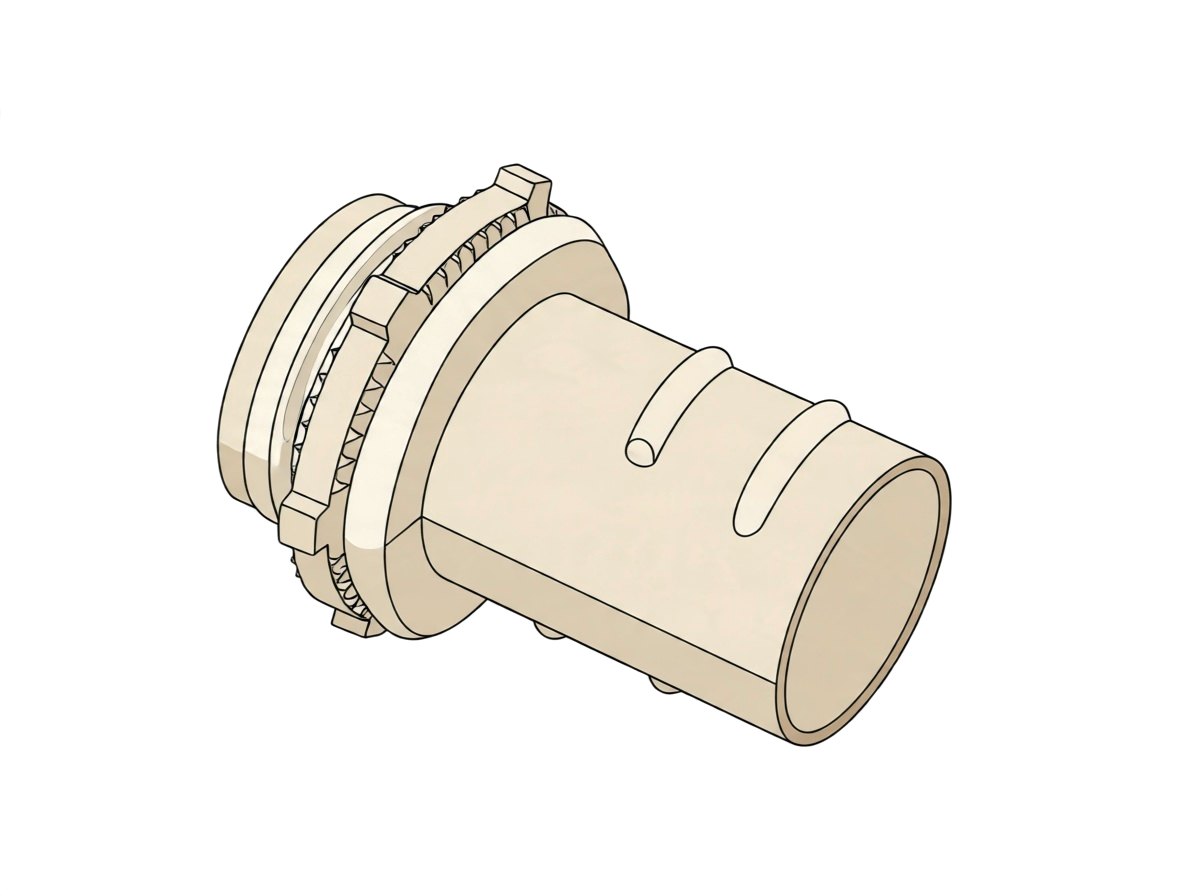
How it connects
The barrel is pushed into the cut end of the conduit and turned so its spiral ribs engage the conduit's helical convolutions, like a coarse self-tapping thread. No clamp or screw; holds mechanically and bonds electrically. Not sealed.
Male and female halves
This is the male half: the ribbed barrel goes inside the conduit. The conduit's spiral bore acts as the female. The other end of the same fitting is usually a male straight enclosure thread with a locknut, or a second screw-in barrel on couplings.
Usually connects to
- Inner helical convolutions of matching FMC/Greenfield, including reduced-wall types where approved
- AC/BX or MC cable armor only where the fitting is listed for it
Common sizes
- FMC trade sizes 3/8–2 in, sometimes larger; common choices include 1/2 and 3/4 in.
- Listed ranges vary by maker: 3/8–1-1/4, 3/8–1-1/2, and 3/8–2 in.
Where it is used
Residential/commercial electrical rough-in and branch circuitsFlexible-conduit raceways to boxes/panelsEquipment/motor lead and whip connections
Variations
- Straight box connector with locknut and NPS-style enclosure thread
- 90° connector
- Screw-in coupling with two male insert barrels
- Insulated or uninsulated throat
- Die-cast zinc, malleable iron or steel
How to recognise it
A plain cylindrical barrel, slightly smaller than the conduit ID, with 1-3 raised diagonal or helical ribs (often interrupted segments) on its outside. It is usually opposite a hex/lug body and a male threaded hub with locknut. No clamp screw or nut on the flex side.
Often confused with
| Confused with | How to tell them apart |
|---|---|
| FMC squeeze connector | Squeeze connectors receive the conduit inside a split saddle clamped by a screw; screw-in barrels go inside the conduit and have helical ribs on the outside. |
| FMC set-screw connector | Set-screw type has a female socket with a screw bearing on the conduit outer surface; no external spiral ribs. |
| Liquidtight (LFMC) connector | LFMC fittings use a ferrule, sealing ring and compression nut over the jacketed conduit; screw-in FMC fittings have no nut or seal. |
| NPT / straight conduit thread | The barrel ribs are few, very coarse, often interrupted and pitched to the conduit convolution, not a fine standard thread. |
| Standard NPT / NPSM male pipe thread | FMC screw-in stems have smooth cylindrical walls interrupted only by a few spaced coarse spiral ribs matching conduit pitch, rather than continuous 60° V-threads. |
Also called
twist-in flex connectorscrew-in flex coupling endScrew-in flex connector stemFMC screw-in fitting endInternal thread FMC stemGreenfield screw-in fittingscrew-in FMC coupling end
Good to know
The barrel rib geometry is not a standard thread. It is sized to each trade size of FMC and varies by maker. The enclosure-thread end of these fittings is a separate port (straight electrical/NPSM-type conduit thread with locknut).
Related connections
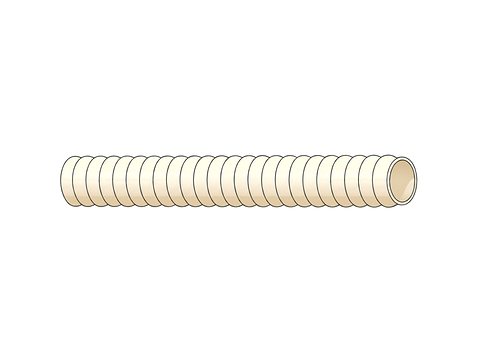 FMC Conduit Plain End
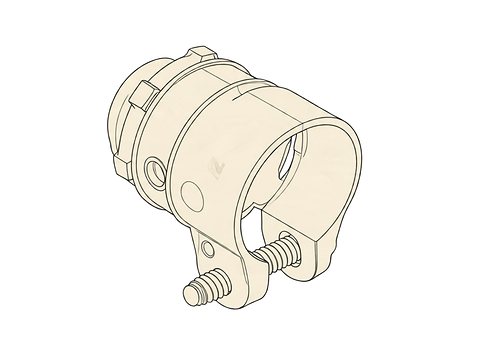 FMC Armored-Cable Squeeze-Clamp Socket
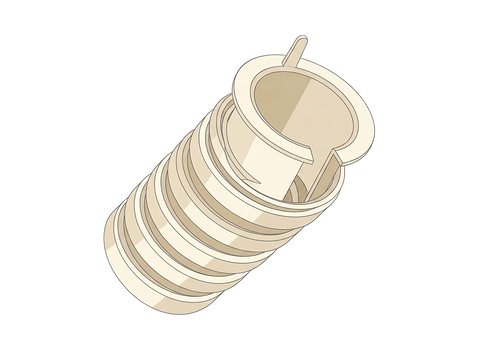 FMC Anti-Short Bushing Receiving End
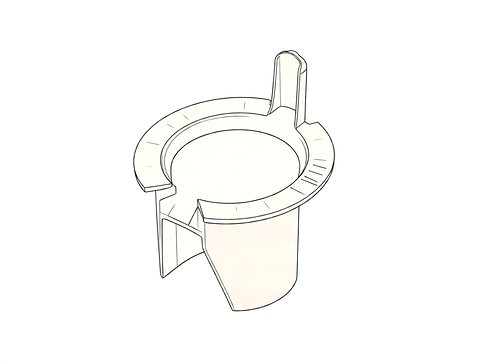 Armored-Cable Anti-Short Bushing
Design with real parts
Crafti checks which parts connect, right in your browser.