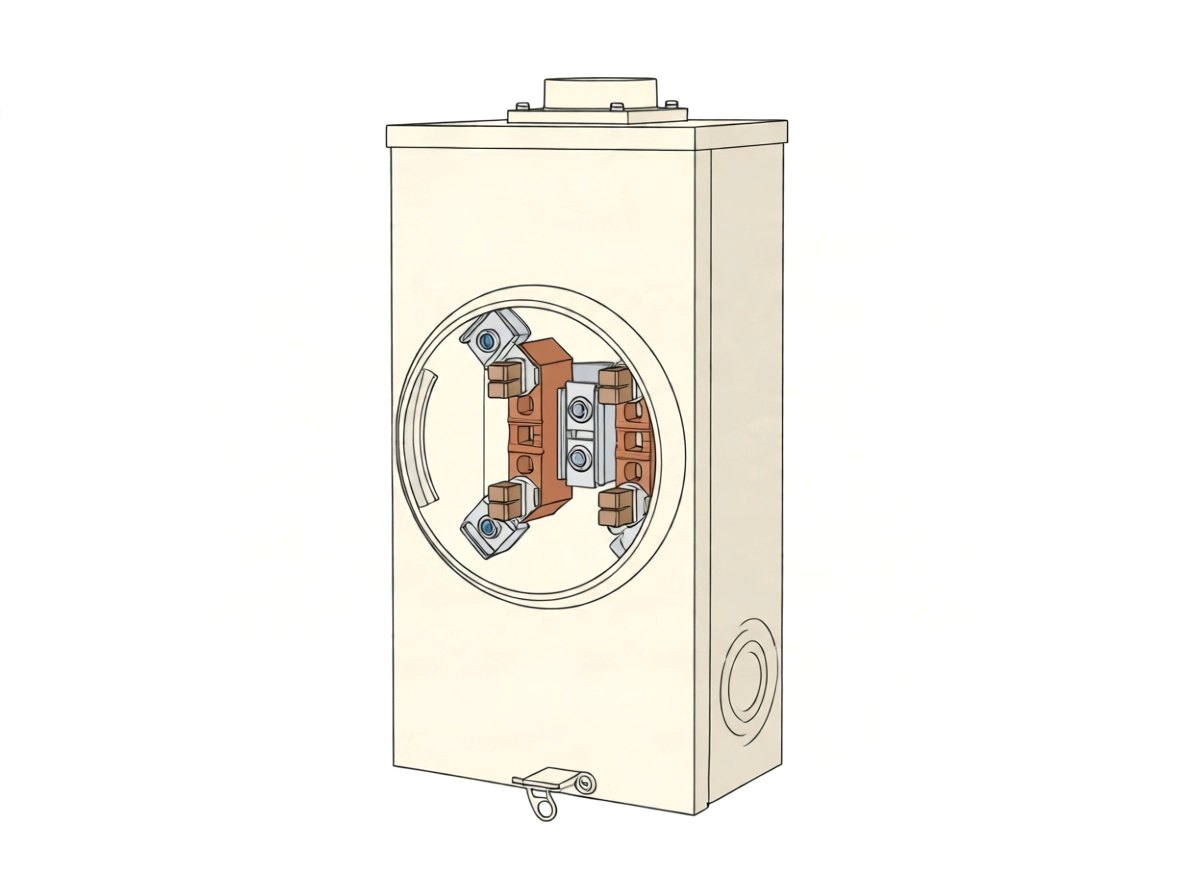
How it connects
The 4 male stabs on the rear of a watthour meter insert into spring-loaded female jaws making heavy wiping contact. During maintenance or meter removal, external jumper cables clamp onto the protruding horn lugs to bypass utility power.
Male and female halves
Female receptacle (four spring-loaded contact jaw clips with outward-pointing bypass horns) mating with the male stabs (blades) of a standard socket-type (S-base) watthour meter.
Usually connects to
- Matching four-blade ANSI C12.10 Form 2S or Form 1S detachable/socket-type watt-hour meter
- Utility bypass jumper cable with clamp/socket connectors
Common sizes
- Form 2S four-jaw format; listed blade centres are about 75 mm horizontal × 78 mm vertical.
- Typical ratings: 100, 125, 135 or 200 A, with versions up to 320 A continuous and 600 VAC.
- Opening/flange measurements vary in the descriptions: 118–130 mm openings, 168–170 mm cover openings and roughly 7 in (178 mm) flanges. Match the exact socket and meter rather than treating these as one dimension.
Where it is used
Residential/light-commercial electric serviceUtility revenue/watt-hour meteringMulti-position meter centersCommercial submeteringUtility distribution
Variations
- ringless 4-jaw meter socket with lever bypass
- ringless 5-jaw meter socket with horn bypass (with 5th terminal for network/polyphase)
- no bypass
- 5-jaw conversion (with 5th terminal accessory for network or 3-phase/Form 12S metering)
- Ring-type 4-jaw meter socket (requires sealing ring)
- 5-jaw meter socket (includes 5th jaw terminal for network/phase/neutral monitoring)
How to recognise it
Four spring-loaded copper/bronze jaw clips arranged in two vertical pairs behind a circular ~7-inch cover opening without an external sealing ring flange, distinguished by small metal horn tabs protruding outward from the top and bottom jaw terminals.
Often confused with
| Confused with | How to tell them apart |
|---|---|
| ring-type 4-jaw meter socket | Ring-type sockets secure the meter using an external sealing ring around an extruded collar on the cover, whereas ringless sockets secure the meter by clamping the meter flange directly behind the enclosure front cover. |
| lever bypass meter socket | Lever bypass sockets have an internal mechanical lever mechanism that closes bypass contacts and releases jaw pressure, whereas horn bypass sockets have static metallic horn tabs extending from the line and load jaws intended for external utility bypass jumpers. |
| Ring-type electric meter socket | Ring-type sockets use an external circular sealing ring/clamp around the protruding collar, whereas ringless sockets clamp the meter flange under the one-piece front panel. |
| 5-jaw electric meter socket | 5-jaw sockets have an extra terminal (usually at the 9 o'clock position) for a neutral connection on 120/208V 3-wire network services. |
| 5-jaw or 7-jaw electric meter socket | A 4-jaw socket has exactly 4 contact clips (2 line on top, 2 load on bottom) for single-phase 3-wire service, whereas 5-jaw or 7-jaw sockets have additional clips for 3-phase or network metering. 4-jaw sockets have exactly four spring-clip contacts for 1-phase 3-wire service, whereas 5-jaw and 7-jaw sockets have additional fifth or seventh jaw terminals for 3-phase or network metering. |
Also called
4-jaw ringless horn bypass meter base; 4-jaw horn bypass meter socketForm 2S meter socket receptacle with horn bypassfour terminal S-base meter socket with horn bypass4-terminal meter base4-terminal meter can4-jaw watthour meter enclosure socket4-terminal ringless meter socketringless electric meter base
Good to know
In utility metering nomenclature, 'ringless' refers to the enclosure retaining mechanism (cover fits over meter flange without a sealing ring), and 'horn bypass' refers to the manual utility jumper horns. The electrical mating interface itself is standard ANSI C12.7 Form 2S 4-jaw S-base female.
Related connections
Design with real parts
Crafti checks which parts connect, right in your browser.