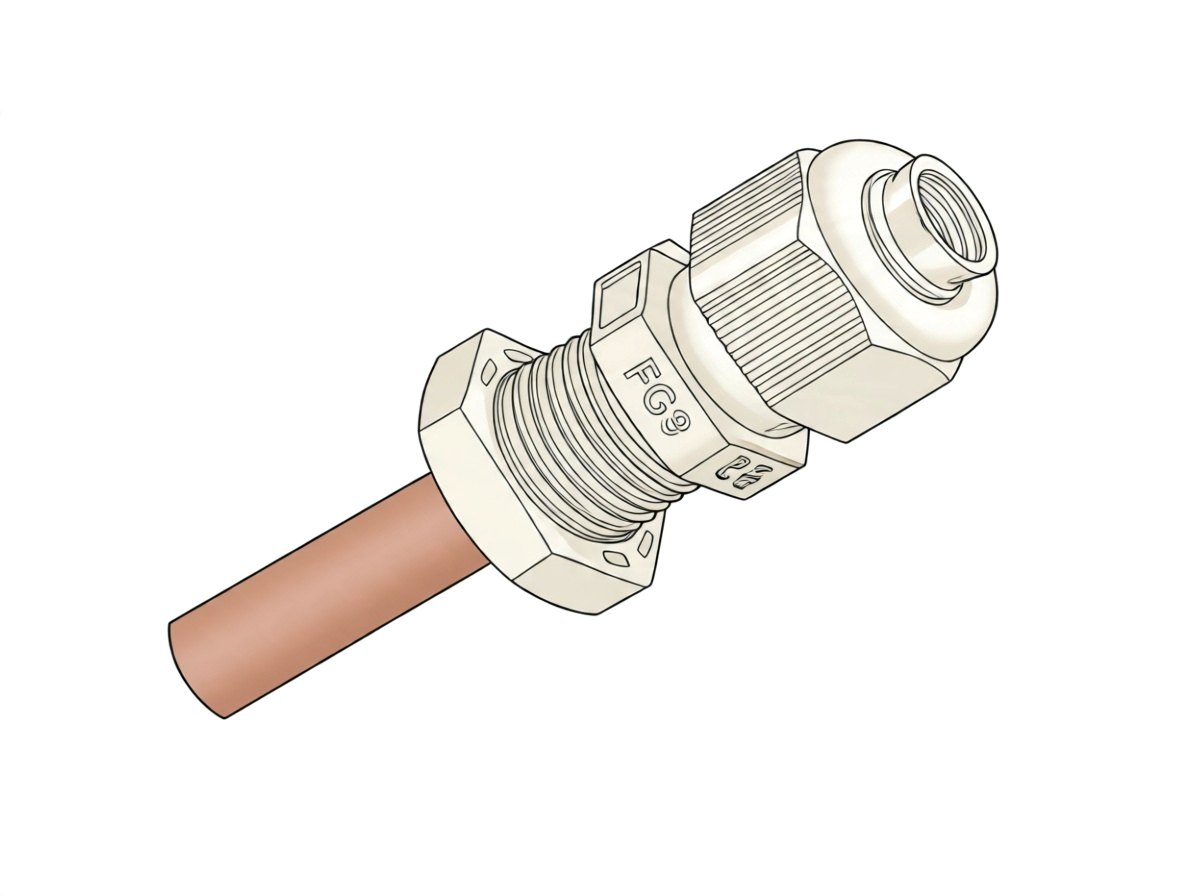
How it connects
Cable is pushed through the open cap nut; tightening the nut on the gland body compresses a rubber/TPE seal insert (often via collet fingers) radially onto the cable jacket, giving IP66/IP68 sealing and strain relief.
Male and female halves
Ungendered in standard terms; the gland is the receiving (female) side and the cable jacket is inserted into it. The gland's other end is usually a male entry thread (M, PG or NPT) — a separate port.
Usually connects to
- Round jacketed electrical cable, multicore cable or flexible power cord within the gland’s clamping range, such as 3–6.5 mm
- Multi-conductor wire harness of suitable size
Common sizes
- Select by cable OD clamping range, separately from mounting thread. Gland families span about 2 mm (0.08 in) to over 50 mm (2.0 in) cable OD.
- Example ranges: 2–5, 3–6.5, 4–8, 5–9, 5–12.5, 6–12, 10–14 and 13–18 mm.
- Bodies include M12–M63 and PG7–PG48; a 3–6.5 mm grip can use 1/4 in NPT, PG7 or M12 × 1.5. M20 commonly grips 5–9 mm.
- One example specifies 0.580–0.625 in cable OD with a separate 3/4 in male mounting thread.
Where it is used
Electrical enclosures/junction boxesIndustrial automation/control panelsMachinery wiringWaterproof inline connectorsOutdoor electronics/lightingMarine/harsh environmentsHazardous areas
Variations
- Single-compression unarmored or double-compression armored, with inner/outer seals
- EMC/EMI/RFI shield-braid contact
- Explosion-proof Ex
- Multi-hole insert
- Inline splice body with glands at both ends
- Dome cap, including nylon
- Spiral/bend-relief cap
- Reduced dome for smaller cable range
How to recognise it
Hex or domed cap nut with a round opening, a visible rubber seal ring inside, often slotted plastic fingers under the nut; size range in mm moulded or printed on the part or listing.
Often confused with
| Confused with | How to tell them apart |
|---|---|
| Gland entry thread (M20 / PG / NPT) | The body thread enters an enclosure or nut; the opposite cap-nut end grips and seals the cable jacket. |
| Passive grommet / snap-in bushing | A simple rubber ring lines a panel hole against abrasion, without a compression nut or active adjustable cable clamp. |
| Tube/pipe compression fitting | A metallic or plastic ferrule seals rigid or semi-rigid fluid tube. A cable gland uses a resilient sleeve or clamping fingers around a flexible cable jacket and is selected by cable OD range. |
Also called
Cable glandCord grip/strain-relief glandCable/cord connector (US)Dome-nut cable entrySingle-compression glandCable seal/clamping insertLiquidtight cord grip
Good to know
On an M20 5–9 mm IP68 inline connector, 'M20' names the gland body size. The cable entry is defined by its clamping range rather than an exposed mating thread.
Related connections
Design with real parts
Crafti checks which parts connect, right in your browser.