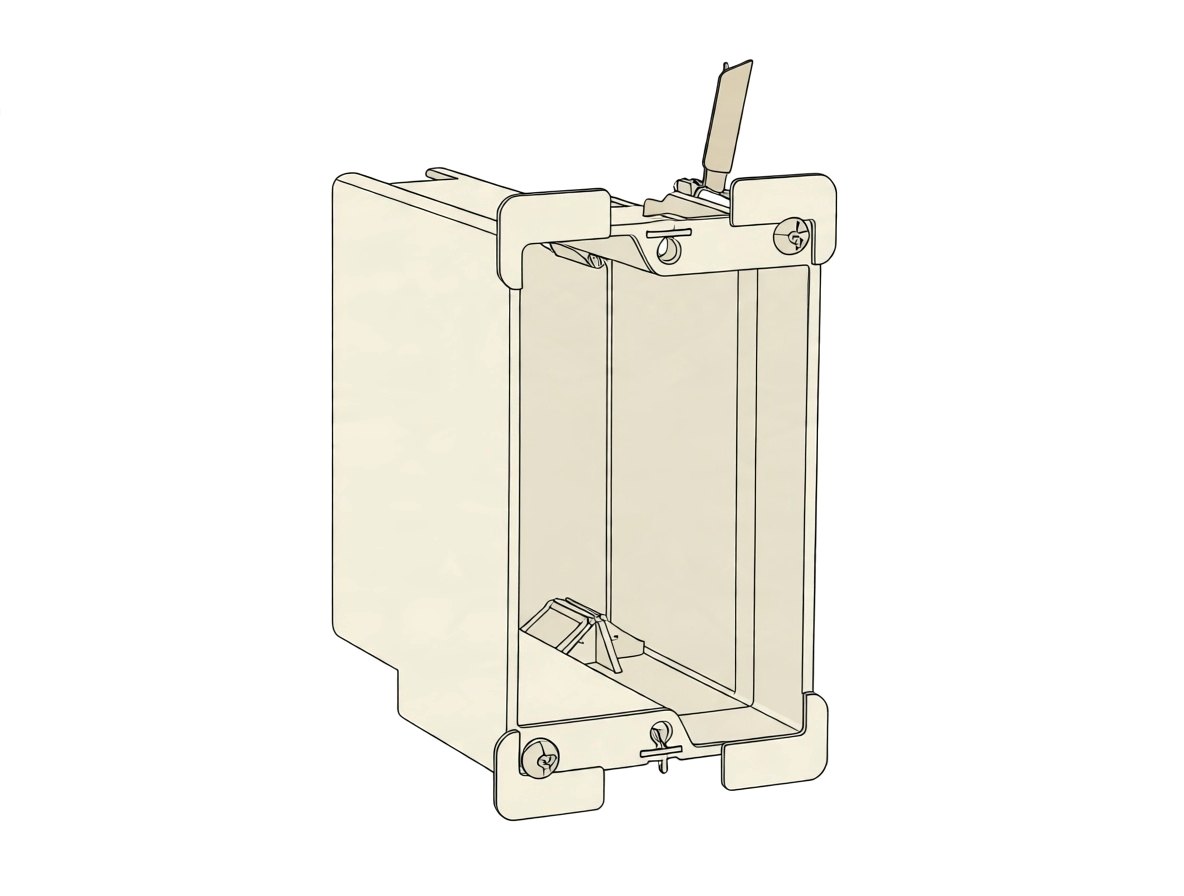
How it connects
Tightening the front-facing drive screw first frictionally rotates the plastic or metal wing 90 degrees outward against a travel stop, then draws the wing forward along the screw thread to pinch the wall panel against the front flange.
Male and female halves
Clamp mechanism gripping a flat planar surface; box flange provides the front stop while the pivoting jaw/wing provides the rear clamping face.
Usually connects to
- Wall or ceiling panel surrounding the correctly sized box cutout: drywall/gypsum/plasterboard/Sheetrock
- Plywood or wood paneling
- Plaster and lath
Common sizes
- Wall range depends on the box: examples span 1/8–1-1/4 in (3–32 mm), commonly 1/2–5/8 in drywall; other listed ranges include 3/8–3/4 or 7/8 in and 1/4–1 in.
- Clamp jaws can be about 12 × 25 mm. Wall boxes include 1–3 gangs; ceiling boxes include roughly 3-1/2–4-1/4 in round sizes.
- Legrand C118WAC accepts 1/8–1-1/4 in wallboard/paneling; confirm the actual product range and cutout.
Where it is used
Residential/commercial electrical retrofit/remodelAdding switch/receptacle boxes in finished wallsLow-voltage/AV cut-in plates and mounting ringsCeiling/light-fixture boxes
Variations
- Plastic/metal rotating swing wing, including Carlon-style ears
- Single-screw Pass & Seymour/Slater swing bracket
- Speaker-style flip-out dog ear
- Low-voltage old-work ring
- Rectangular/gang or two-clamp round-ceiling box
- Madison/battery-hanger metal straps (different mechanism, same purpose)
How to recognise it
Identified by diagonal or corner-mounted long screws accessible from the box face that drive flip-out rectangular plastic or metal tabs positioned along the exterior side walls.
Often confused with
| Confused with | How to tell them apart |
|---|---|
| Madison bars / Madison hangers / F-clips | Madison bars are separate flexible metal sheet straps slipped alongside a steel box and bent over, whereas old-work clamps are integral screw-driven rotating wings. |
| Electrical cable clamp | NM cable clamps secure electrical cables entering the box knockout openings, rather than securing the box to the drywall. Cable clamps grip cable at a box entry; swing dogs grip the wall behind the box’s front flange. |
| Drywall screw mounting | The swing dog sandwiches the panel against a flange rather than driving a fastener through the panel into a stud. |
| Madison bar / F-strap (battery hanger) | Separate flat metal straps slid beside the box and bent over its edge, rather than screw-rotated brackets built into the box. |
| New-work nail-on box | New-work boxes have nails or a side flange for fastening to a stud, not panel-gripping ears. |
Also called
Old work box swing clamp; Old work box swing bracket; Swing-clamp box mountingRemodel box wing clampOld work ear flipper clampDrywall swing tabOld-work mounting wing; old work box wingsswing earswing wingflip-out clamp
Good to know
Commonly found on Carlon / Thomas & Betts (e.g. B114R), Legrand Pass & Seymour, and Allied Moulded old-work boxes, as well as architectural recessed speakers and low-voltage caddy brackets.
Related connections
Design with real parts
Crafti checks which parts connect, right in your browser.