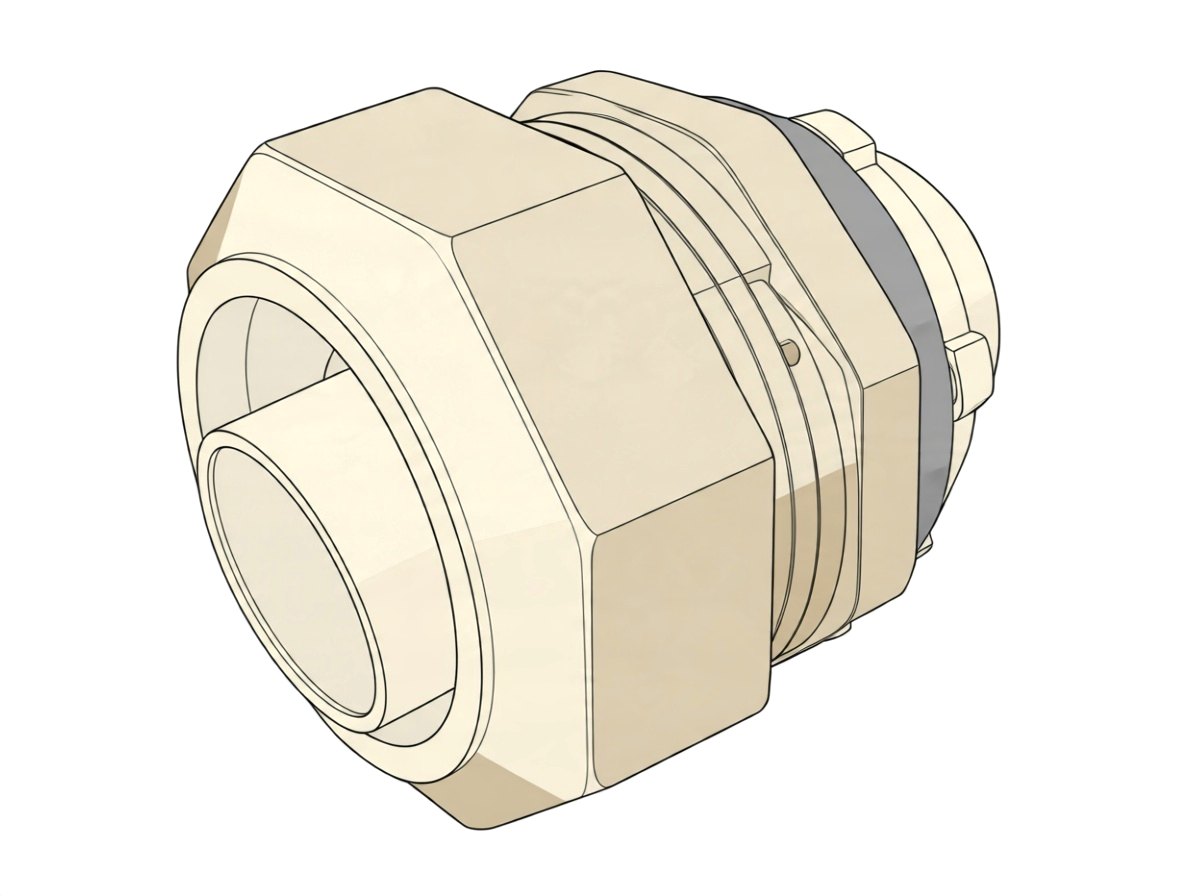
How it connects
Conduit is pushed over the internal sleeve (ferrule) into the body; tightening the compression nut squeezes a sealing ring/gland onto the conduit's outer jacket, retaining it and making a liquidtight seal. Metal versions also bond the conduit.
Male and female halves
This is the female/receiving end that accepts the conduit; the conduit itself acts as the male part. The opposite end of the fitting is typically a male conduit thread ("MPT") into a knockout or hub.
Usually connects to
- Matching LFNC-B liquidtight nonmetallic conduit, such as Carflex, Ultratite or Sealproof Type B
- LFNC Type A/B or LFMC (UL 360) only where the particular connector specifies that conduit type
Common sizes
- LFNC-B trade sizes commonly 3/8–2 in, with some lines reaching 4 in; 1/2, 3/4 and 1 in are most common.
- Match the conduit trade size and nonmetallic type, not just a similar metallic fitting.
Where it is used
Motor/industrial-machinery wiringHVAC disconnects, heat pumps and air conditionersPool/spa/pump equipmentOutdoor/wet-location wiringResidential/commercial electrical work
Variations
- Straight, 45° or 90° connector
- PVC/nylon/nonmetallic body
- Zinc, steel or aluminum body, including nonmetallic gland
- Insulated throat
- Grounding-ferrule type
How to recognise it
A domed or hex compression nut on one end with a tubular sleeve visible inside the opening (annular gap between sleeve and nut for the conduit wall), a body hex, and usually an O-ring plus male thread and locknut on the other end. Often marked 'liquidtight' or with conduit trade size.
Often confused with
| Confused with | How to tell them apart |
|---|---|
| Cable gland / cord grip | Cable glands grip a round cable directly with a split seal and have no internal sleeve going inside a conduit. |
| PVC conduit solvent-weld socket | A slip socket has a smooth bore with no compression nut or internal sleeve. |
| Female NPT conduit hub | A threaded hub has internal threads, not a nut over a projecting sleeve. |
| LFMC Liquidtight Metallic Conduit Fitting | LFMC fittings require a grounding ferrule specifically designed for flexible metal core conduit, whereas LFNC-B fittings are typically all-nylon or use smooth nonmetallic ferrules specifically sized for nonmetallic integral reinforced condu LFMC fittings have a ferrule that threads into the metal core and often a grounding ferrule; LFNC-B fittings are for all-plastic conduit and usually marked 'LFNC-B' or 'Type B'. |
| Rigid PVC Conduit Female Slip Socket | Rigid PVC conduit female slip sockets are unthreaded solvent-weld sockets for rigid pipe, lacking the internal ferrule and threaded compression gland nut of LFNC-B connectors. |
Also called
liquid-tight connector conduit end; liquid-tight flexible nonmetallic conduit fittingLFMC connectorSealtite fittingliquidtight compression fitting; Type B Liquidtight Non-Metallic Conduit Connector; Liquidtight Non-Metallic Conduit Fitting; LFNC-B connector conduit endCarflex ConnectorNMUA Connectornonmetallic liquidtight connectorNMLT connector
Good to know
Metallic and nonmetallic liquidtight conduits have different ODs; connectors are usually listed for one type. 'Female' here refers to the conduit-receiving socket, not a female thread.
Design with real parts
Crafti checks which parts connect, right in your browser.