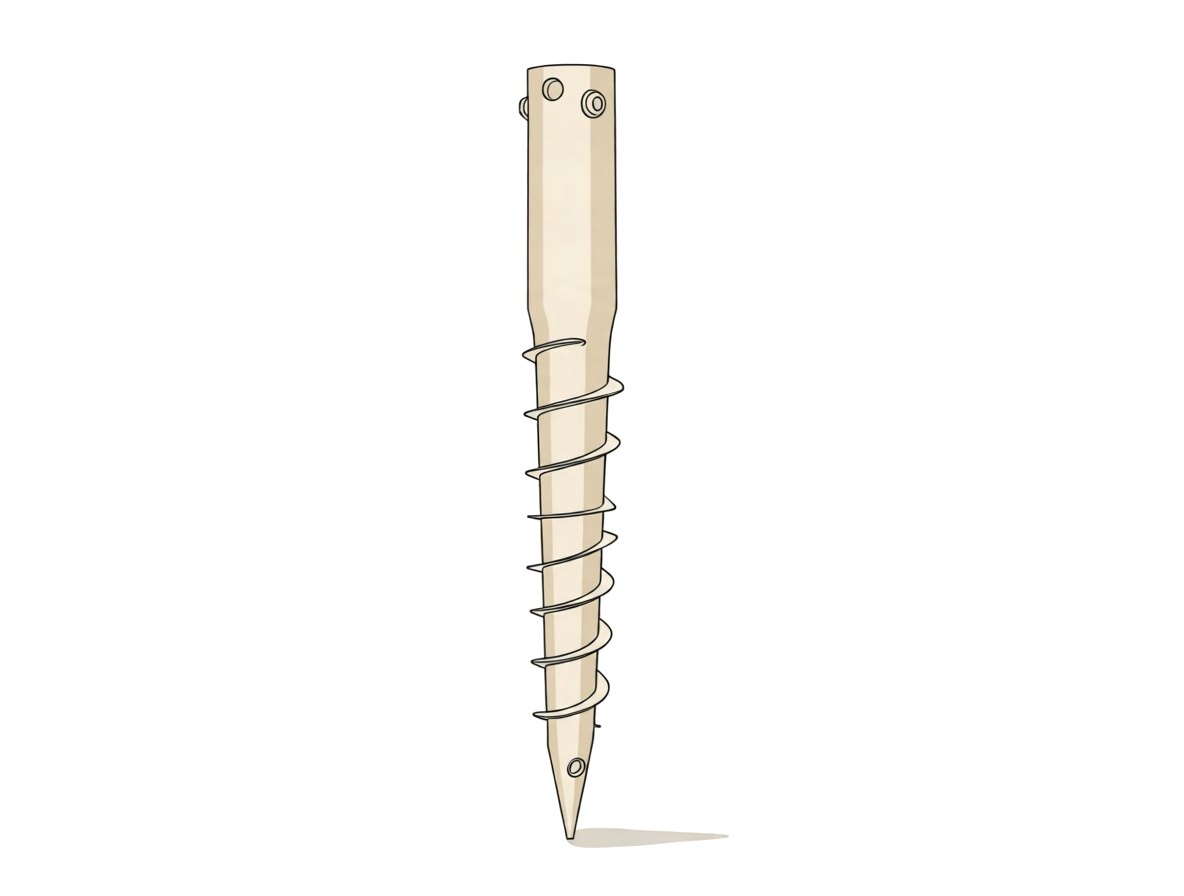
How it connects
Screws directly into soil or ground substrate via rotational torque; external helical flights bite and embed into earth to provide tension (uplift) and compression load bearing without requiring concrete excavation.
Male and female halves
Male externally threaded/flighted shaft mating with unprepared or pre-drilled earthen substrate acting as the female receiving matrix.
Usually connects to
- Soil/earth substrate, including compacted soil, clay or gravel; deeper strata may be dense soil or bedrock
- Guy wire or tie-down strap
Common sizes
- Consumer/utility anchors include 3/8–1 in (10–25 mm) shafts, 1.5–6 in (40–150 mm) helices and 10–48 in (250–1200 mm) lengths; light utility lines extend to 1-1/2 in shafts, 3–14 in helices and 15–66+ in lengths.
- Structural lines use 1/2–2-1/4 in solid square shafts or 1-1/2–8-5/8 in hollow pipe, 3–16 in helices and lengths from 15 in to over 10 ft.
- Other listed ranges include 30–114 mm shafts (over 300 mm industrial), 60–400+ mm helices and 0.5–3+ m lengths.
Where it is used
Solar panel ground-mount rackingFence and mailbox post anchoringDeck and pergola footingsCivil and rail infrastructureManufactured housing tie-downsUtility pole and tower guy wire anchoringFoundation underpinning and deep foundationsTrellising and fencing
Variations
- Continuous ground-screw spiral
- Segmented/multiple helix
- Solid square SS or round tubular RS shaft
- Manual eye-head/no-wrench or power-installed anchor
How to recognise it
Recognized by a central steel tube or solid bar tapering at the base to a point or chisel tip, surrounded by a prominent continuous or stepped steel spiral/flighting along the ground-penetration section.
Often confused with
| Confused with | How to tell them apart |
|---|---|
| Standard concrete post-anchor / driven pile | Helical ground screws rotate into virgin/compacted earth with spiraling steel flights rather than requiring drilled excavation pits, poured concrete footings, or purely percussive pile driving. |
| Continuous-flight ground screw | Continuous ground screws have continuous auger threading along the tapered tip/tube, whereas helical anchors feature one or more discrete circular helical plates welded to a central shaft. |
| Earth percussion anchor (duckbill anchor) | Percussion anchors are driven into the ground straight with a drive steel rod and set by pulling on a wire/cable, rather than screwed into the soil via rotation. Percussion anchors are driven into the ground with a rod and set by tensioning a wire rope, whereas helical anchors are screwed into the ground via rotating helical plates. Percussion anchors are driven straight into the ground and tipped horizontal on tension via an attached wire tendon, rather than screwed into soil using a continuous helix or spiral flight. |
| Continuous ground screw / screw pile | Ground screws typically have continuous spiral threads along a tapered hollow pipe body, while helical anchors feature distinct circular helix plates welded onto a solid or tubular shaft. |
Also called
Helical pierScrew pileEarth screw anchorHelical earth anchorHelical pileGround screw anchorhelical ground anchor; spiral ground anchorauger earth anchor
Good to know
The screw pile or ground anchor embeds into virgin or compacted ground.
Related connections
Design with real parts
Crafti checks which parts connect, right in your browser.