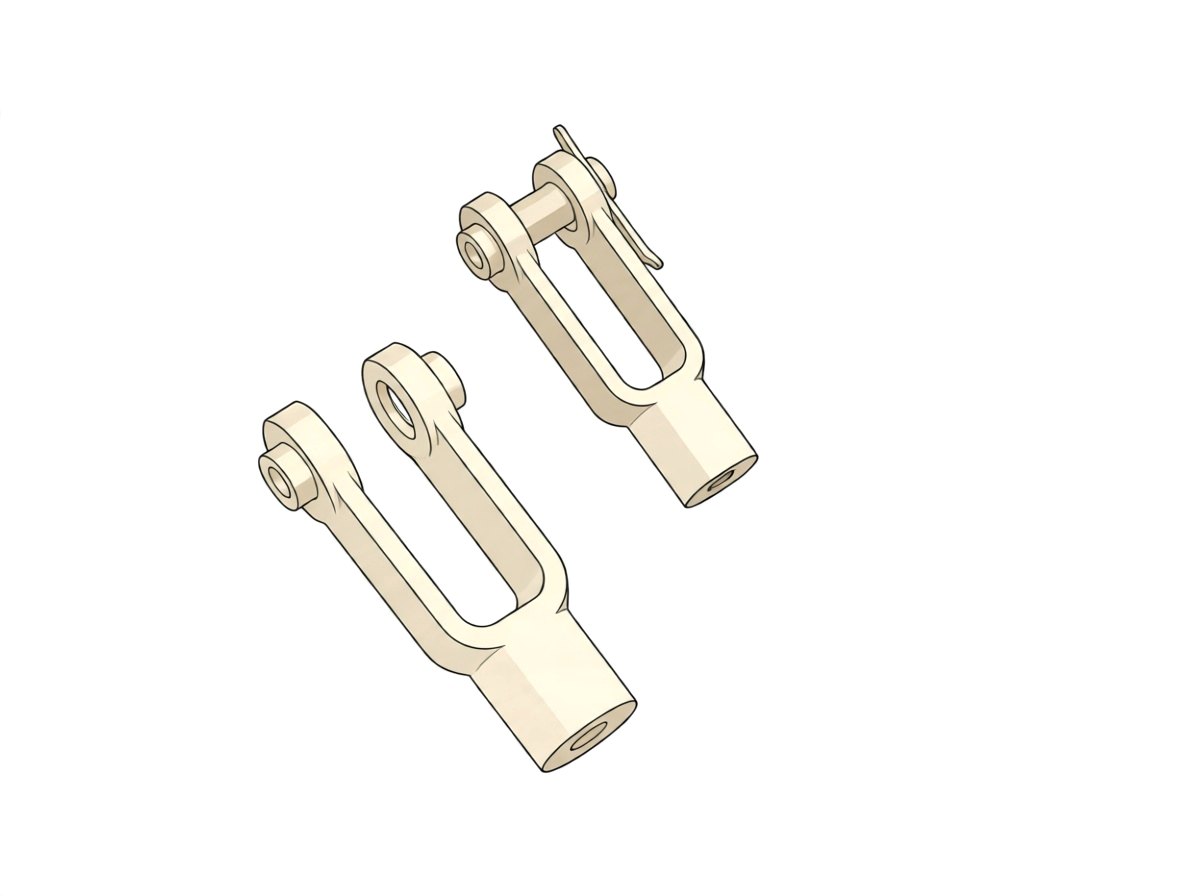
How it connects
The mating tongue or eye slides into the gap between the lugs; a clevis pin (retained by a cotter pin or R-clip) or a bolt with nut passes through both lugs and the tongue hole, forming a pin joint that can pivot about the pin. No seal.
Male and female halves
The fork/jaw is the 'female' half (it receives); the single-lug tongue, eye or rod eye is the 'male' half. This port is the jaw (female).
Usually connects to
- Clevis pin through the fork and mating eye, tongue, lug, tab or chain plate
- Rod eye, shackle eye or thimble eye
- Garage-opener door bracket or straight/curved arm, including Genie 26012D/26013D
Common sizes
- Specify pin diameter, fork gap and pin-to-mouth depth. DIN 71752 clevises run M4–M20+ with about 4–20 mm pins; turnbuckle-jaw sizes run roughly 1/4–2+ in.
- Garage-door examples use 5/16 in (0.3125 in, about 8 mm) or 3/8 in (0.375 in) pins, lengths about 1–1-5/8 in and flange spacing about 1–1-1/4 in.
- Genie 5987J04.S/5987F04/19792B examples use 3/8 in pins with 1-1/4–1-1/2 in usable length.
Where it is used
rigging and turnbucklespneumatic/hydraulic cylinder rod endslinkages and actuatorstrailers and agricultural hitchesmarine standing riggingresidential garage door openerscommercial garage door operators; commercial overhead door openers; commercial overhead door operatorswire-rope and cable tensioning
Variations
- turnbuckle jaw end
- threaded clevis rod end (DIN 71752 / ISO 8140)
- welded clevis
- clevis with spring/safety clip pin; bolt-and-nut jaw vs clevis-pin-and-cotter jaw
- Single-lug pivot hole
- Double-lug clevis bracket / yoke slot on carriage; Screw-drive carriage clevis mount; Belt/chain drive inner trolley clevis mount
- Chamberlain/LiftMaster 41A5047 style bracket; Genie 19792A style bracket
- heavy-duty operator reinforcement bracket pivot
How to recognise it
Look for a forked end: two parallel flat ears with aligned cross holes and an open slot between them, usually with a pin or bolt through, often a cotter pin. Measure pin diameter, gap width and mouth-to-pin depth.
Often confused with
| Confused with | How to tell them apart |
|---|---|
| Shackle | A shackle is a separate bent U/bow with a removable pin; a clevis jaw is a rigid fork integral to a rod or body. |
| Eye end | An eye is a single closed loop/hole (male half); the jaw has two lugs with a gap between. |
| Rod end (heim joint) | A heim/rod end has a spherical ball bearing in a single eye; a clevis has a straight pin through two lugs. |
| Garage door header bracket clevis joint | The header bracket connects the rail to the wall framing above the door, whereas the carriage door-arm pin joint connects the traveling carriage to the door push/pull arm. |
| Garage door arm bracket clevis pin female | Located on the door-mounted bracket on the garage door panel rather than on the traveling trolley/carriage on the opener rail. |
Also called
jaw end; turnbuckle jawfork end; yoke endclevis jointgarage door carriage clevis holetrolley arm pivot hole; carriage door-arm pin hole; door arm bracket pivot pin; Genie carriage door arm pivotgarage door opener door bracket pivotoperator arm clevis connectionGenie trolley clevis pin connection
Good to know
Clevis fit depends on pin diameter and fork gap. A 16 mm gap and 10 mm pin describe a particular part rather than a universal size. The fork mates with an eye or tongue.
Related connections
Design with real parts
Crafti checks which parts connect, right in your browser.