How it connects
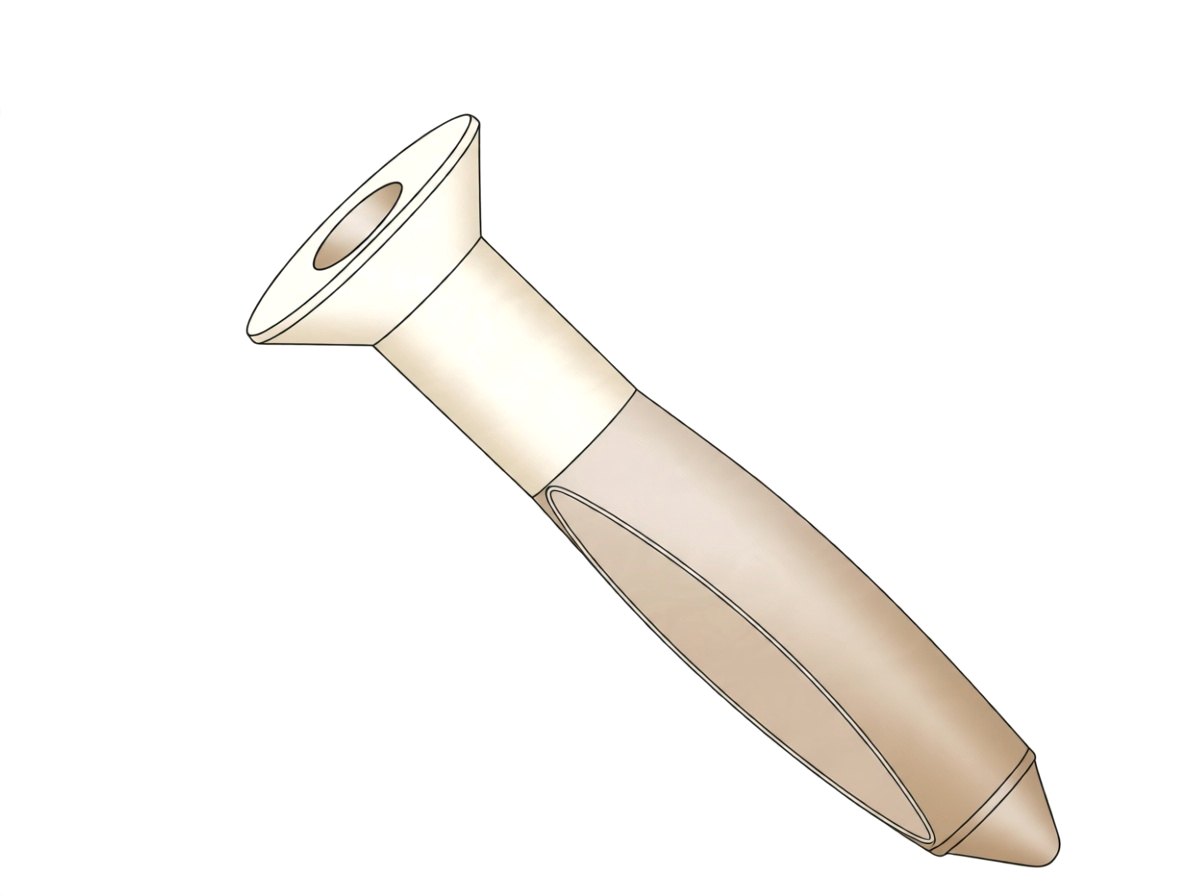
The conical underside of the head wedges into a matching chamfered or countersunk hole in the fixture as the anchor is driven home, seating flush and exerting axial clamping force.
Male and female halves
Male head bearing profile mating into a female countersunk or chamfered clearance hole in a fixture.
Usually connects to
- Matching beveled/conical countersunk clearance hole or fixture seat
- Countersunk finishing washer
Common sizes
- Common countersink angles: 82° inch/ASME, 90° metric/ISO/DIN and 100° aerospace/sheet metal; masonry examples also list 74–82° or 80–90°.
- Masonry anchors with 3/16 or 1/4 in shanks have heads roughly 3/8–1/2 in (9.5–12.7 mm); a 1/4 in example is about 0.49 in (12.4 mm), with lengths 1-1/2–4 in.
- The broader feature spans micro screws through over 1 in, or M1.6–M24+.
Where it is used
structural fasteningframing and fixturesmasonry construction; masonry fasteningfixture mountingwood-to-concrete anchoring; wood-to-concrete framingarchitectural metal fixture attachmentwoodworkingmachinery
Variations
- 74° or 82° inch countersink, including ASME B18.3/B18.6.3
- 90° metric countersink, ISO 10642/DIN 7991
- Flat-head split/drive anchor
- Round/mushroom DSD, duplex, pan or tie-wire anchor counterpart
How to recognise it
Recognised by a completely flat, unslotted circular top surface transitioning to a conical tapered bearing underside designed to sit flush when hammer-driven into countersunk fixtures.
Often confused with
| Confused with | How to tell them apart |
|---|---|
| Round Head / Domed Head Split Drive Anchor | Round heads project above the fixture surface and bear on a flat underside, whereas countersunk heads have a conical bearing face that sits flush in a chamfered hole. Round heads protrude above the fixture surface with a flat bearing underside, whereas countersunk heads have a conical underside and flat top that sits flush. |
| standard machine countersunk screw head | Split drive countersunk heads are solid and drive-less on top (struck with a hammer), whereas screws have drive recesses such as Phillips, Torx, or slotted. Split drive countersunk anchor heads lack drive recesses (no Phillips, Torx, or slotted drive) because they are installed by hammer impact rather than rotation. |
| Countersunk clearance hole | The clearance hole is the female conical recess in the fixture, while the bearing head is the solid male conical flange of the anchor. |
| mushroom head anchor seat | Mushroom heads sit proud on top of flat fixture surfaces with a flat underside rather than countersinking flush. |
Also called
CSK Headcountersunk flat headcountersunk anchor headflat head anchor bearing surface; countersunk head bearing surfacecountersunk fixture seatflat head countersink seatconical underhead bearing surfacecountersunk head underhead taper
Good to know
In split-drive anchors like Simpson Strong-Tie CSD, the head is struck directly with a hammer without any screwdriver or hex tool slot. The anchor body expands into masonry while the countersunk head retains the fixture. Additional standard references: DIN 7991; ISO 10642.
Related connections
Design with real parts
Crafti checks which parts connect, right in your browser.