How it connects
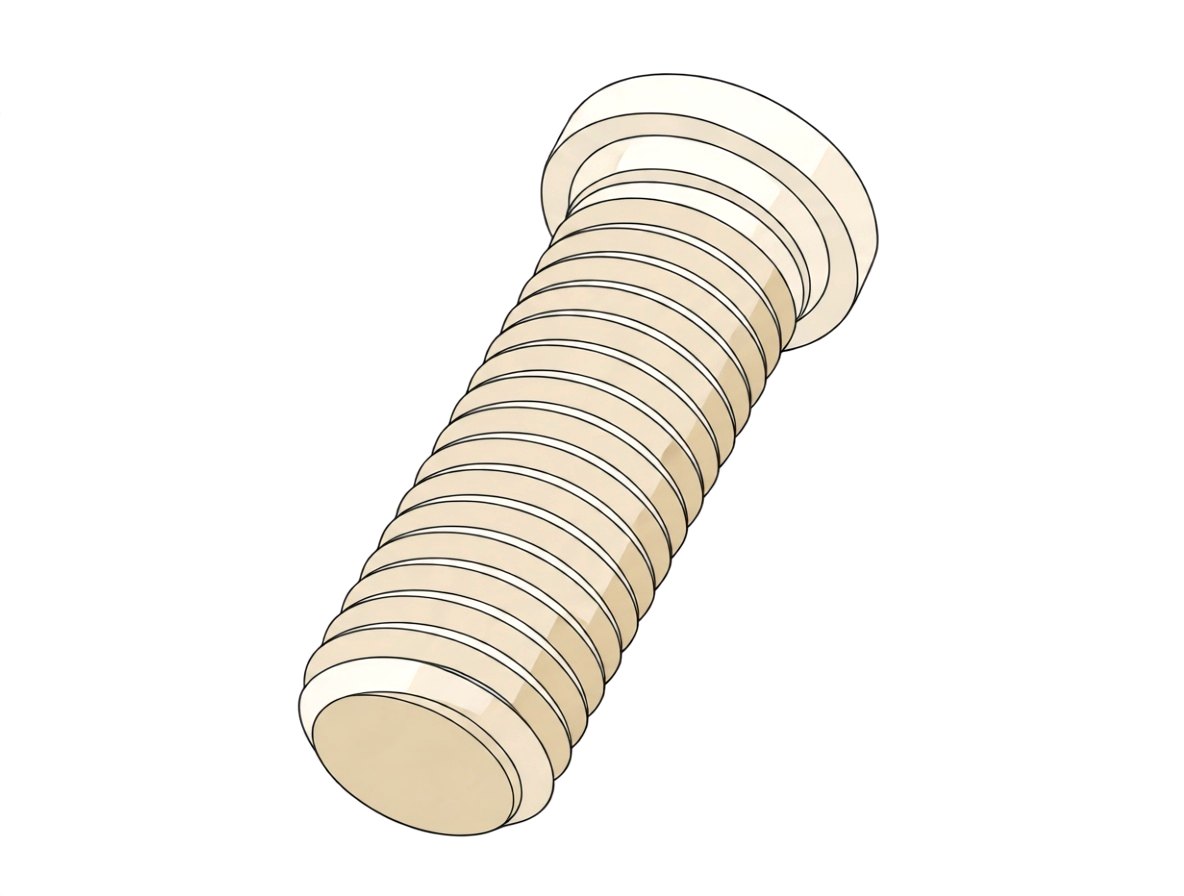
Stud is welded (stud-welded or projection-welded) or pressed into the enclosure wall; the mounted item or lug slides over the stud and is clamped by a mating M6 nut, often with a washer.
Male and female halves
This is the male (external thread) half; the mating female half is an M6 nut or tapped hole.
Usually connects to
- M6 hex nut / flange nut / wing nut; M6 hex nut (M6x1.0)
- equipment mounting plate slots or holes; M8 tapped clamp body or mounting plate
- ring terminal / grounding lug
- M5 x 0.8 nut; M5 coupling nut
- M5 tapped hole (internal thread); M8 internal threaded hole
- M8 nut
Common sizes
- Enclosure studs commonly M4–M8, with lengths about 10–40 mm; US alternatives include #10-32 or 1/4-20.
- M5 coarse uses 0.8 mm pitch; uncommon larger fine threads can share that pitch.
- M6 uses 1.0 mm coarse or 0.75 mm fine pitch; M8 uses 1.25 mm coarse, with 1.0 and 0.75 mm fine variants.
Where it is used
control panelssheet-metal fabricationgrounding and bonding; electrical enclosure grounding studsfastenerspneumatic fittingsriggingstructural hangingbeam clamps; machinery lifting points
Variations
- M6x1.0 coarse; M8x1.25 (standard coarse)
- M6x0.75 fine; M8x1.0 (fine)
- drawn-arc weld stud; weld stud (ISO 13918); capacitor-discharge (CD) weld stud
- self-clinching (PEM-type) stud
- M5 x 0.5 fine (different pitch, not interchangeable)
- left-hand M5 x 0.8
- M8x0.75 (extra fine)
- full-thread stud (DIN 976)
How to recognise it
A short threaded rod sticking out of an enclosure back wall or door, usually with a small flange or weld fillet at its base. On US-made enclosures, check the spec sheet to see if it is metric or 1/4-20 / #10-32 before you assign M6.
Often confused with
| Confused with | How to tell them apart |
|---|---|
| 1/4-20 UNC stud | 1/4 in is 6.35 mm vs 6 mm; 20 TPI (1.27 mm pitch) vs 1.0 mm pitch. Check with a thread gauge or the manufacturer's drawing. |
| #10-32 UNF stud | About 4.8 mm diameter and much finer thread; often used on US enclosures. 4.83 mm, 32 TPI (0.79 mm pitch); nearly same pitch, slightly smaller diameter; very common in US pneumatics and partially engages M5, so check the spec. |
| #10-24 UNC | 4.83 mm diameter, 24 TPI (1.06 mm pitch); visibly coarser and won't thread into M5. |
| M5 x 0.5 fine | Same diameter, finer pitch; measure with a pitch gauge. |
| 5/16"-18 UNC male thread | 5/16"-18 has an outer diameter of ~7.94 mm and a pitch of ~1.41 mm (18 TPI), slightly looser thread pitch than M8x1.25; they will bind after 1-2 turns. |
Also called
weld studmounting stud; ground studbonding stud; M5 studM5 x 0.8M5 coarse threadM8 eye bolt threadM8 eyebolt male thread; M8-1.25 male thread (if coarse)M6 threaded stud
Good to know
Confirm diameter and pitch from the enclosure datasheet. A US-market stud may use 1/4-20 or #10-32 instead of metric thread. M6 commonly uses coarse M6 × 1.0. Additional standard references: ISO 262.
Related connections
Design with real parts
Crafti checks which parts connect, right in your browser.